
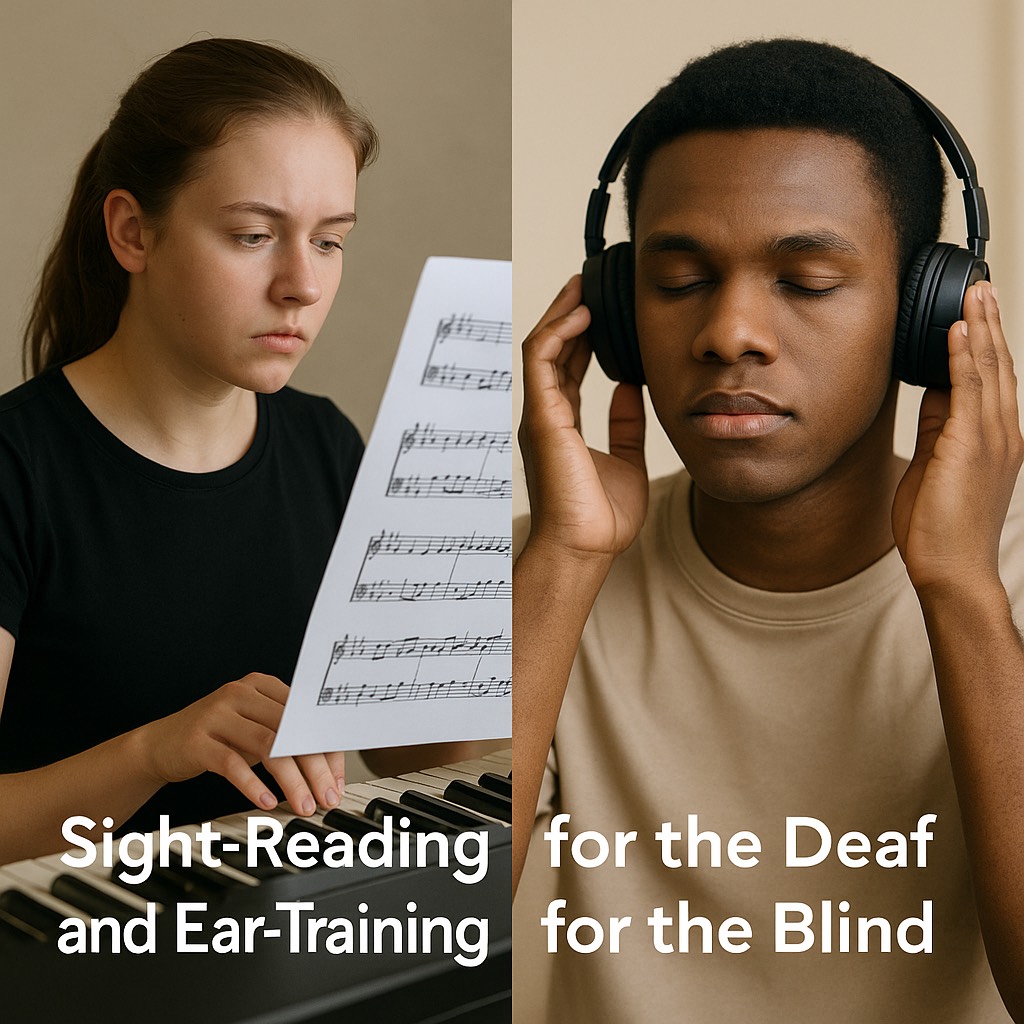
Expanding Musical Horizons: The Power of Sight-Reading for the Deaf and Ear-Training for the Blind
Music is often thought of as an art form experienced primarily through sound—but in reality, it transcends any single sense. For individuals who are Deaf or blind, music remains a powerful tool for communication, creativity, and connection. By embracing adaptive strategies like sight-reading for Deaf musicians and ear-training for blind musicians, we open up new dimensions of musical engagement that honor both the diversity of human experience and the boundless nature of music itself.
Sight-Reading Music for the Deaf: A Visual Language of Expression
For Deaf and hard-of-hearing musicians, the absence or limitation of auditory input doesn’t mean the absence of music. In fact, many Deaf musicians have a deep, physical and visual relationship with music—feeling vibrations, watching movement, and reading musical notation with acute sensitivity.
Sight-reading—the ability to read and interpret written music in real time—offers tremendous benefits:
- Empowerment through Literacy: Just as written language unlocks literature, written music unlocks a rich world of expression. Sight-reading allows Deaf musicians to independently explore compositions, perform in ensembles, and even compose their own works.
- Collaboration in Ensembles: When playing in a group, sight-reading allows Deaf musicians to stay in sync with others without relying on auditory cues. Visual indicators in the score—like dynamics, tempo, and rhythm—provide all the necessary information to stay connected.
- Expression Through Precision: With mastery of sight-reading, Deaf musicians can interpret complex pieces, express emotion through tempo and dynamics, and communicate musical ideas clearly—all through the visual architecture of music.
- Connection Beyond Sound: Music becomes a shared visual language, especially in communities where ASL (American Sign Language) and other visual communication tools already play a central role. Reading music extends this fluency into the artistic realm.
Ear-Training for the Blind: Trusting the Inner Map
For blind and low-vision musicians, music often begins—and thrives—in the auditory world. But beyond simply listening, ear-training develops a musician’s ability to recognize, remember, and reproduce musical patterns with accuracy and depth.
The benefits of ear-training for blind musicians are transformative:
- Internalization of Music: Without the distractions of reading notation, blind musicians often build incredibly strong auditory memories. Ear-training sharpens this natural strength, enabling quick learning and deep retention.
- Navigating by Sound: In both solo and ensemble settings, trained ears can pick up subtle musical cues—pitch, harmony, tempo, and form. This allows blind musicians to anticipate changes, adapt to other performers, and lead with confidence.
- Improvisation and Creativity: A strong ear opens the door to improvisation, songwriting, and fluid musical conversations. Many blind musicians become expert improvisers because of their keen ability to “hear ahead.”
- Inclusive Performance Spaces: With ear-training, blind musicians are not limited by printed scores or visual cues. They can learn and perform alongside sighted peers, using alternative methods such as Braille music or learning by repetition and audio recordings.
Music Is a Multisensory Language
What these two approaches reveal is simple but profound: music is not limited to the ears or the eyes—it is a multisensory, adaptive, and universal form of expression. When we design music education with this in mind, we don’t just accommodate difference—we celebrate it.
- For the Deaf community, sight-reading becomes a tool of autonomy and inclusion.
- For the blind community, ear-training is a bridge to independence and expression.
Both are pathways to deeper musical fluency. Both affirm that everyone—regardless of sensory experience—has the right to participate, to create, and to thrive in the musical world.
Let’s continue to expand access to music, not by assuming limitations, but by building bridges. Music is for all of us—seen, heard, and felt.
